
Why TiltFolio Balanced Is the Foundation
 8 min read
Why TiltFolio Balanced Is the Foundation
Most people think of money as a neutral measuring stick, something stable that allows us to value goods and services. For much of history, that was true. Gold anchored the system, ensuring that money supply grew only as fast as gold stocks did. Prices were remarkably stable for centuries.
That all changed in 1971. When the United States abandoned the gold standard, money stopped being anchored to anything tangible. It became, instead, a policy instrument, something governments and central banks could expand at will to stimulate “growth.”
But growth, as measured in a fiat system, is often a mirage. Milton Friedman put it best: “Inflation is always and everywhere a monetary phenomenon.” When too much money is created, prices rise. Savers pay the price.
This reality creates a dilemma for investors: how do you protect wealth and generate reliable returns in a system where money itself is volatile?
The Fiat Money Dilemma
Over the long run, stocks and real estate have been the biggest winners of the fiat era. Central banks and governments have every incentive to keep asset prices rising, expanding credit, lowering rates, and stimulating demand whenever growth slows.
But here’s the catch: most investors can’t simply load up on stocks and ride out the volatility.
Consider the decade from 2000 to 2010. Stocks went nowhere. The S&P 500 lost half its value twice, once during the dot-com bust and again during the global financial crisis. Even ignoring inflation, the 10-year return was close to zero. After inflation, it was negative.
How many families, or retirees, can sit still through 50% drawdowns and a decade of no progress? For most, the answer is obvious: very few.
The Traditional Fix: 60/40 Portfolios
To solve this problem, financial advisors and robo-advisors typically recommend variations of the 60/40 portfolio: 60% stocks, 40% bonds, rebalanced annually.
But as I’ve explained in earlier posts, this is far from a perfect solution. The 60/40 portfolio is still dominated by equities. In times of inflation, both stocks and bonds often struggle, leaving investors exposed.
Worse, the numbers show that while 60/40 smooths returns somewhat, it doesn’t truly tame volatility. Investors still experience sharp drawdowns and long stretches of disappointing results.
A Smarter Alternative: 50/30/20
At TiltFolio, we wanted a better foundation. So we backtested a simple mix:
To ensure accuracy, I relied on a recent academic paper that describes how to convert bond yields into total return approximations (complete with spreadsheet examples). This methodology enabled a comprehensive backtest of TiltFolio Balanced spanning 1971-2024.
• 30% S&P 500
• 20% Gold
The results were remarkable.
• Annualized volatility: 7.4%
• Maximum drawdown: –18.2%
Equity Curve Performance
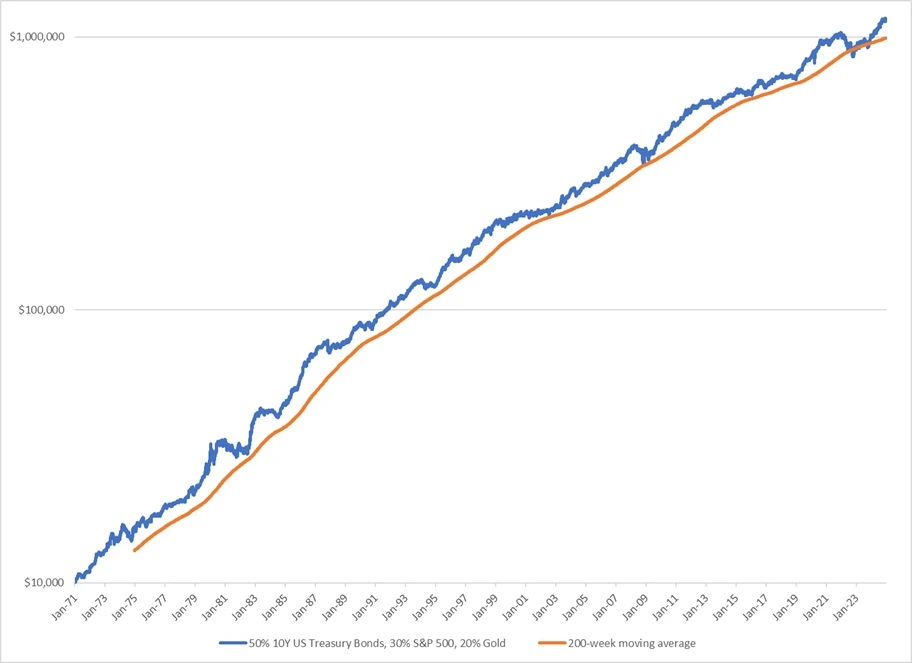
The equity curve shows the smooth, consistent growth of TiltFolio Balanced over time, with far less volatility than traditional stock-heavy portfolios.
Drawdown Analysis
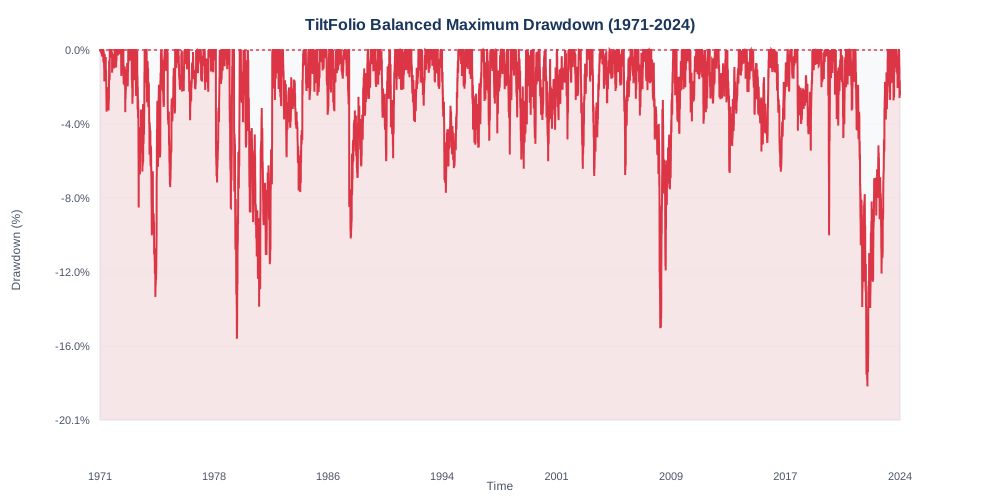
This chart illustrates how TiltFolio Balanced’s drawdowns are both shallower and shorter in duration compared to stock-heavy alternatives, providing better downside protection.
Annual Returns Breakdown
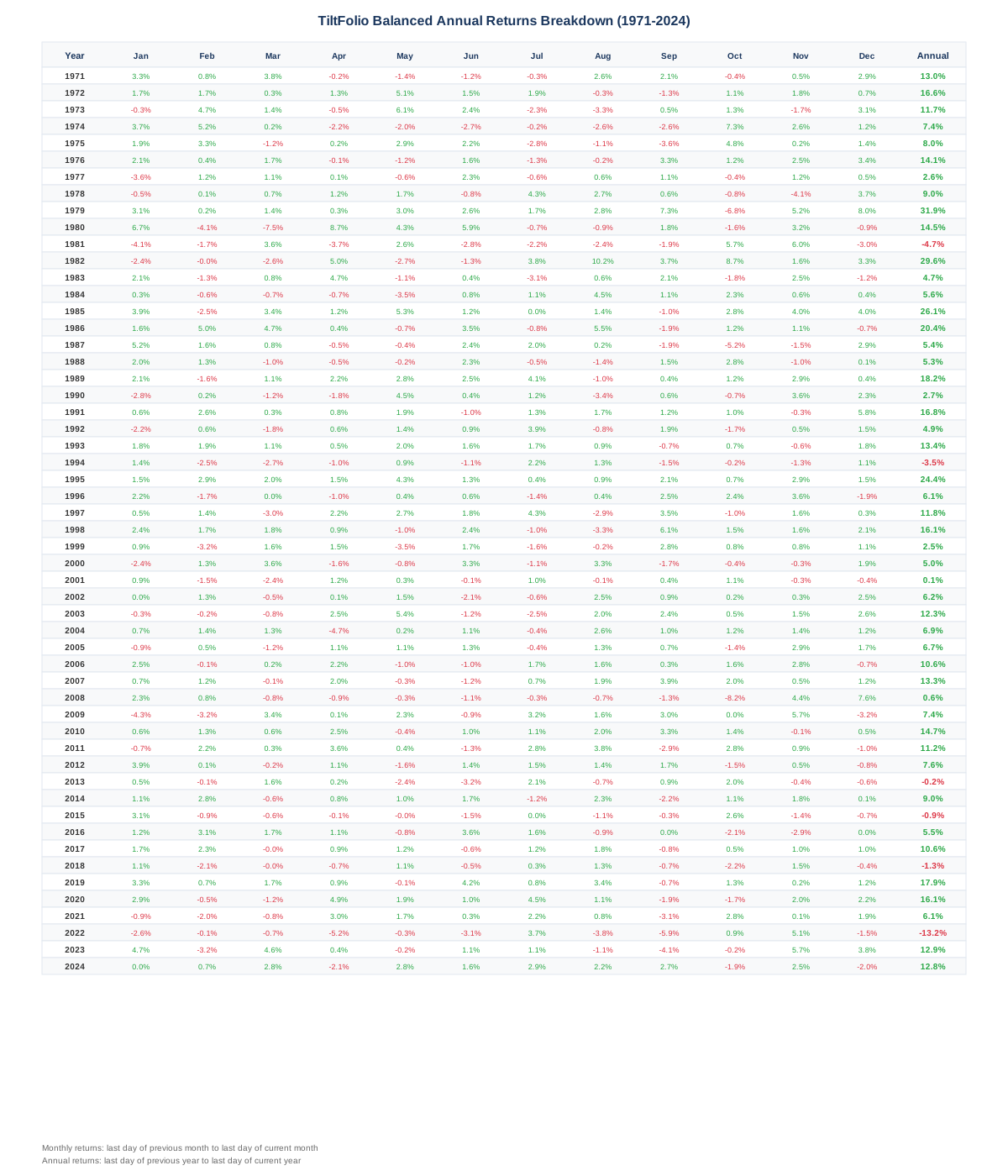
The monthly returns table shows the consistency of TiltFolio Balanced across different market conditions, with only 6 losing years out of 53.
Over 53 years of backtested history:
• A maximum drawdown of just –18% (versus –50% for stocks)
• Less than half the volatility of the S&P 500
This is why TiltFolio Balanced, our 50/30/20 mix, is the starting point for everything we do.
Yes, there are small differences in performance figures depending on how you calculate bond returns (historical bond yield proxies vs. ETF data like IEF and TLT). But the conclusion is the same: a diversified, volatility-balanced mix of stocks, bonds, and gold produces the smoothest buy-and-hold results in the post-gold-standard world.
Why the Mix Works
The exact numbers, 50%, 30%, 20%, aren’t sacred. What matters is the principle:
• Hold more of the less volatile assets (intermediate-term bonds).
• Blend uncorrelated return streams to smooth the ride.
Could you tweak it? Sure. You could add developed-market equities beyond the S&P 500, or include some commodity exposure. You could extend bond maturities to bet on deflation, or hedge currency risk.
But here’s the truth: small tweaks don’t move the needle much. The power lies in the broad structure, stocks, bonds, and gold in balance. That’s what delivers stability.
The Case for Bonds (Even Now)
Many readers are skeptical about the 50% bond allocation. Haven’t bonds been a poor investment lately? Won’t they underperform long term?
It’s true: in a fiat system, bonds face headwinds. But they remain essential for one reason: they provide ballast.
• In times of panic or deflation, demand for bonds surges
• Historically, bonds have been far less volatile than either stocks or gold
Yes, stock-bond correlations have occasionally turned positive, meaning they can fall together. But these relationships shift over time. Nobody can predict future correlations with certainty. If we face another deflationary shock, a scenario many dismiss today, bonds are likely to shine.
That’s why bonds earn their place in TiltFolio Balanced.
What About Commodities?
Another common question is why TiltFolio Balanced doesn’t include commodities beyond gold.
The answer is practical. Commodities are difficult to hold directly. Futures contracts come with rollover costs, limited historical data, and other complications. Our preferred proxy is commodity-producer equities (like energy sector stocks). But data only goes back a few decades, making it tricky to backtest reliably.
Meanwhile, gold does much of the heavy lifting. It often “front-runs” commodity price spikes, moving higher before broad commodity inflation sets in. For long-term buy-and-hold purposes, gold alone is a close-enough proxy.
It’s also important to note: TiltFolio Adaptive, our trend-following system, does include commodity exposure via producer equities. It’s not common, but when trends favor commodities, Adaptive tilts toward them.
Radical Simplicity
The beauty of TiltFolio Balanced lies in its simplicity.
• Annual rebalancing
• Decades of proven resilience
In a world where investment products grow ever more complex, Balanced is radically straightforward. It does exactly what a benchmark portfolio should do: generate steady returns, protect against inflation, and minimize drawdowns.
You could spend years chasing exotic strategies or fine-tuning weights. But you’d struggle to beat the risk-adjusted performance of this simple 50/30/20 mix.
The Foundation for Everything Else
TiltFolio Balanced is not the whole story. It’s the foundation.
On its own, it’s a smarter alternative to the traditional 60/40 portfolio. But when paired with TiltFolio Adaptive, it becomes part of something greater: a system that balances stability with growth, buy-and-hold with trend-following.
We’ll explore that dynamic further in other posts. But the takeaway here is simple: if you’re looking for the single best starting point for your portfolio in a post-gold-standard world, TiltFolio Balanced is it.
How TiltFolio Works Series
This post is part of the “How TiltFolio Works” series. Explore all posts in the series:
- TiltFolio Explained: A Smarter Alternative to 60/40 Portfolios
- Explaining TiltFolio Through Car Brands
- Why the Modern World Needs TiltFolio
- Why TiltFolio Balanced Is the Foundation
- The Ancient Origins of Portfolio Diversification
- TiltFolio Balanced as a Market Barometer
- When Simple Beats Sophisticated
- Decades of Perspective: What TiltFolio Balanced Teaches Us About the Future
- Building a Simple Trend-Following System
- Beyond Moving Averages: Why Volatility Trends Matter More Than You Think
- How TiltFolio Adaptive Differs From Traditional Trend-Following
- Will Trend-Following Keep Working?
- When Trend-Following Underperforms
- How to Avoid Curve-Fitting in Trend-Following
- The “Secret” to the Best Risk-Adjusted Returns: Correlations
- From Rollercoaster to Escalator: Finding Your Investing A-ha Moment
- TiltFolio’s Main Edge: Reliability That Compounds
- How to Stay Committed to an Investment Plan